
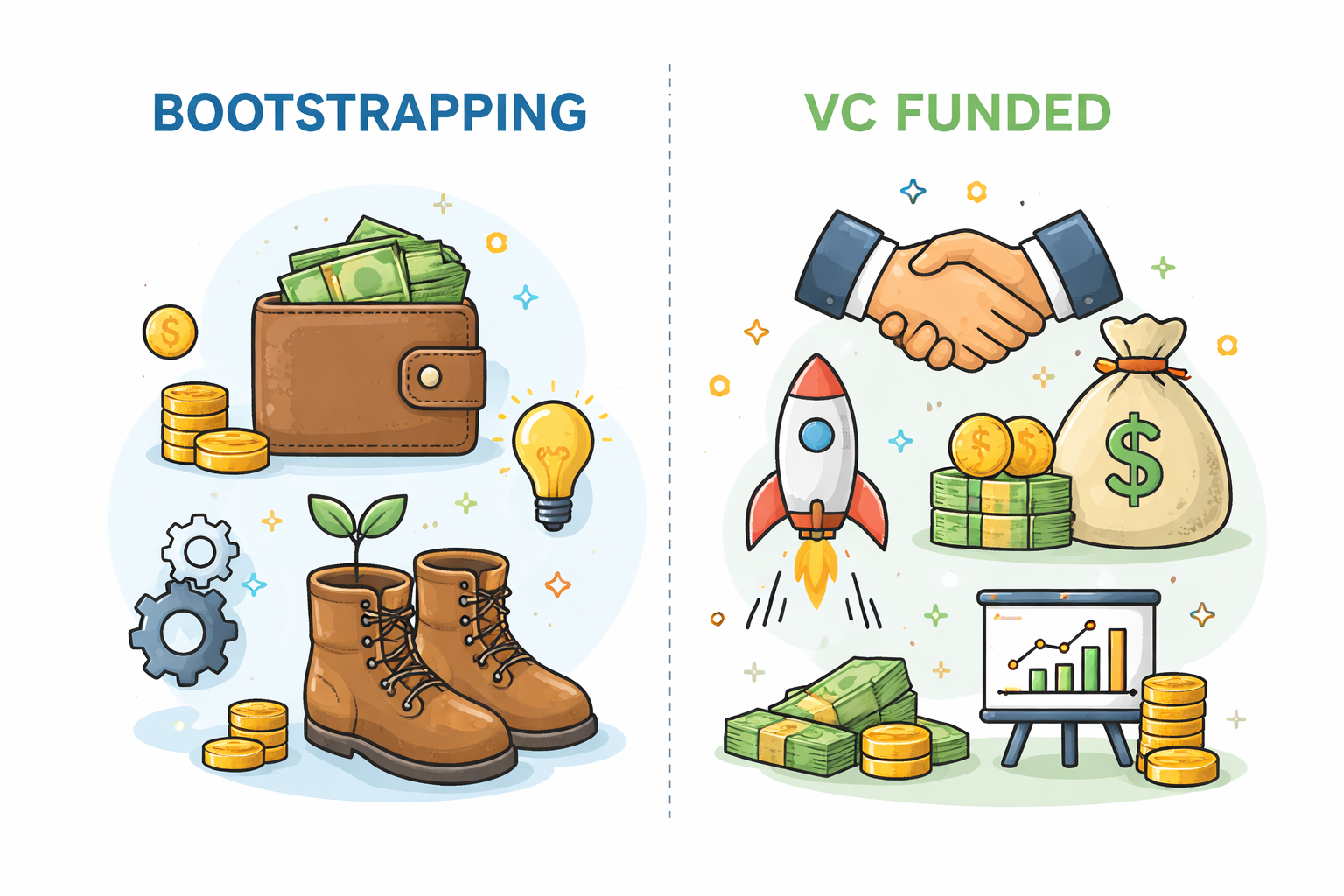
Two Different Paths to Growth
When starting a company, you face a fundamental choice: should you finance growth yourself (bootstrapping) or seek external funding through venture capital? Both paths have their advantages and challenges.
Bootstrapping - Self-Funded Growth
Advantages of bootstrapping:
- Full control: You retain 100% of the company and make all decisions
- Focus on profitability: Forces you to build a sustainable business model
- Flexibility: No pressure from investors to grow at a certain pace
- Learn the basics: Understanding every part of the business
Challenges with bootstrapping:
- Slower growth
- Limited resources for marketing and development
- Harder to compete against well-funded competitors
- Personal financial risk
Venture Capital - External Funding
Advantages of VC:
- Fast growth: Capital to scale quickly
- Expertise and network: Access to experienced advisors
- Credibility: VC backing increases trust with customers and partners
- Recruitment: Ability to hire top talent
Challenges with VC:
- Ownership dilution
- Pressure to deliver extremely high growth
- Less control over strategic decisions
- Exit requirements within certain timeframe
How Do You Choose?
Your choice depends on several factors:
- Market: Does your market require rapid expansion to win?
- Product: Is it capital intensive to develop your product?
- Ambition: Do you want to build a large company quickly or grow organically?
- Personality: Do you enjoy having partners or want full control?
The Hybrid Model
Many successful companies combine both strategies: start with bootstrapping to prove the concept and business model, then bring in VC to accelerate growth once product-market fit is proven.
Conclusion
There's no universally right answer. Both paths can lead to success. What's important is choosing the path that best fits your business idea, market, and personal goals.